A Gentle Starting Point
If your child finds maths hard, you have probably already seen frustration, avoidance or tears over homework. It is natural to wonder whether abacus could help, and equally natural to worry that it might become one more thing that feels like failure. This guide takes a calm middle path. Abacus is not a cure or a treatment for any learning difficulty, and no honest teacher will present it that way. What it can offer many children is a different, very physical way into numbers, one bead, one move and one small success at a time.
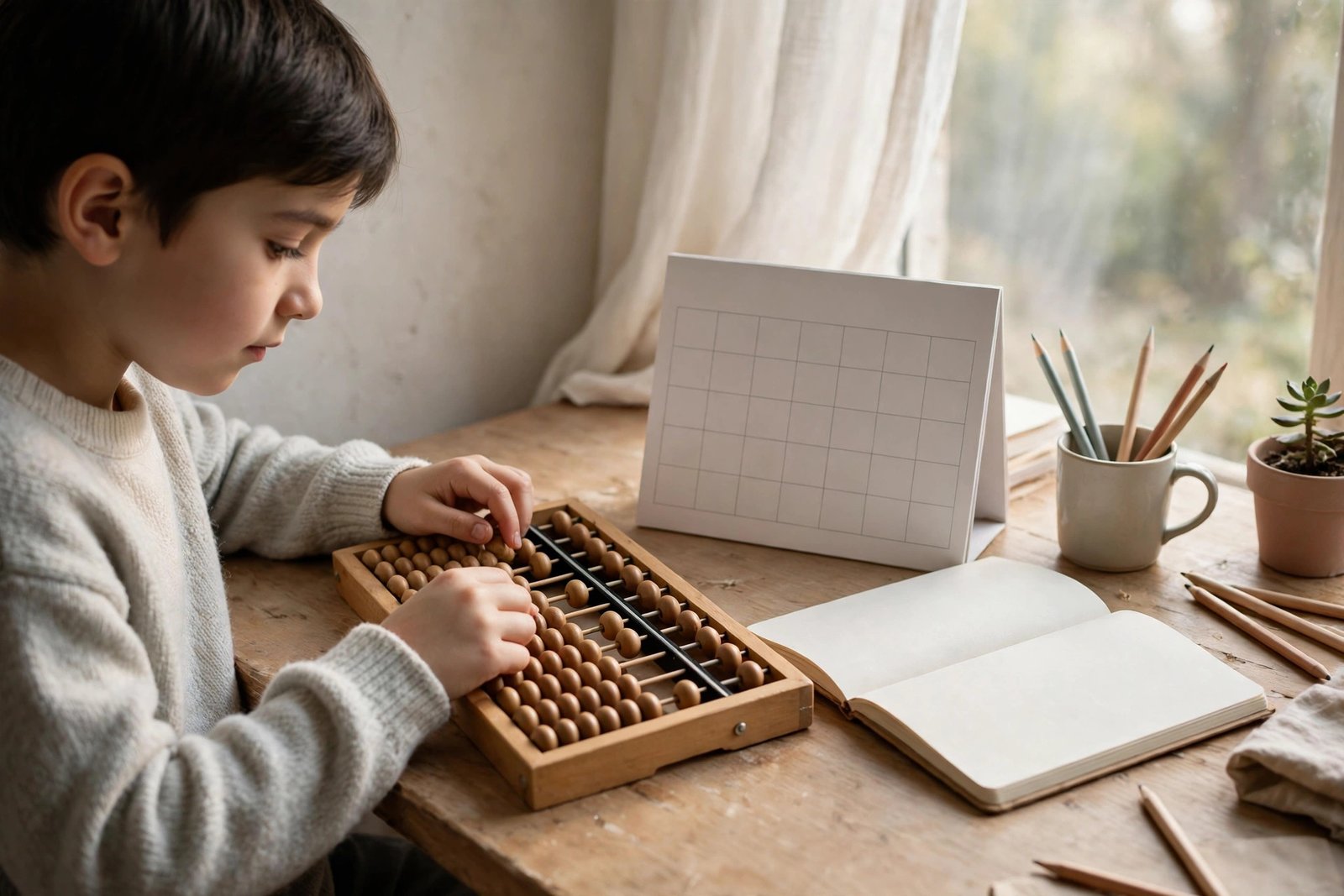
Numbers on a page are abstract. For a child who struggles to hold them in mind, that abstraction can be the biggest barrier. On an abacus, a number is something you can see and touch. Five is not just a symbol. It is a bead moved down to the bar. Quantities appear, change and can be checked by looking and counting. That concreteness is why many parents and teachers find the tool worth trying.
Start with low expectations and high patience. The goal in the early weeks is not speed or levels. It is a child who will sit with the beads willingly, understands what each part does, and experiences getting answers right through their own actions.
Why the Abacus Can Suit Some Struggling Learners
The abacus breaks calculation into tiny, visible steps. Instead of holding a whole sum in memory, a child moves one bead, then the next, following a routine their fingers learn. Routines reduce the load on working memory, and repetition through the hands can make a method stick when written explanations have not.
It also gives immediate, private feedback. If beads are in the wrong place, the mistake can be seen and fixed without a page full of red marks. Children can check their own work by reading the beads back. That sense of control matters for learners whose confidence has been knocked by repeated difficulty at school.
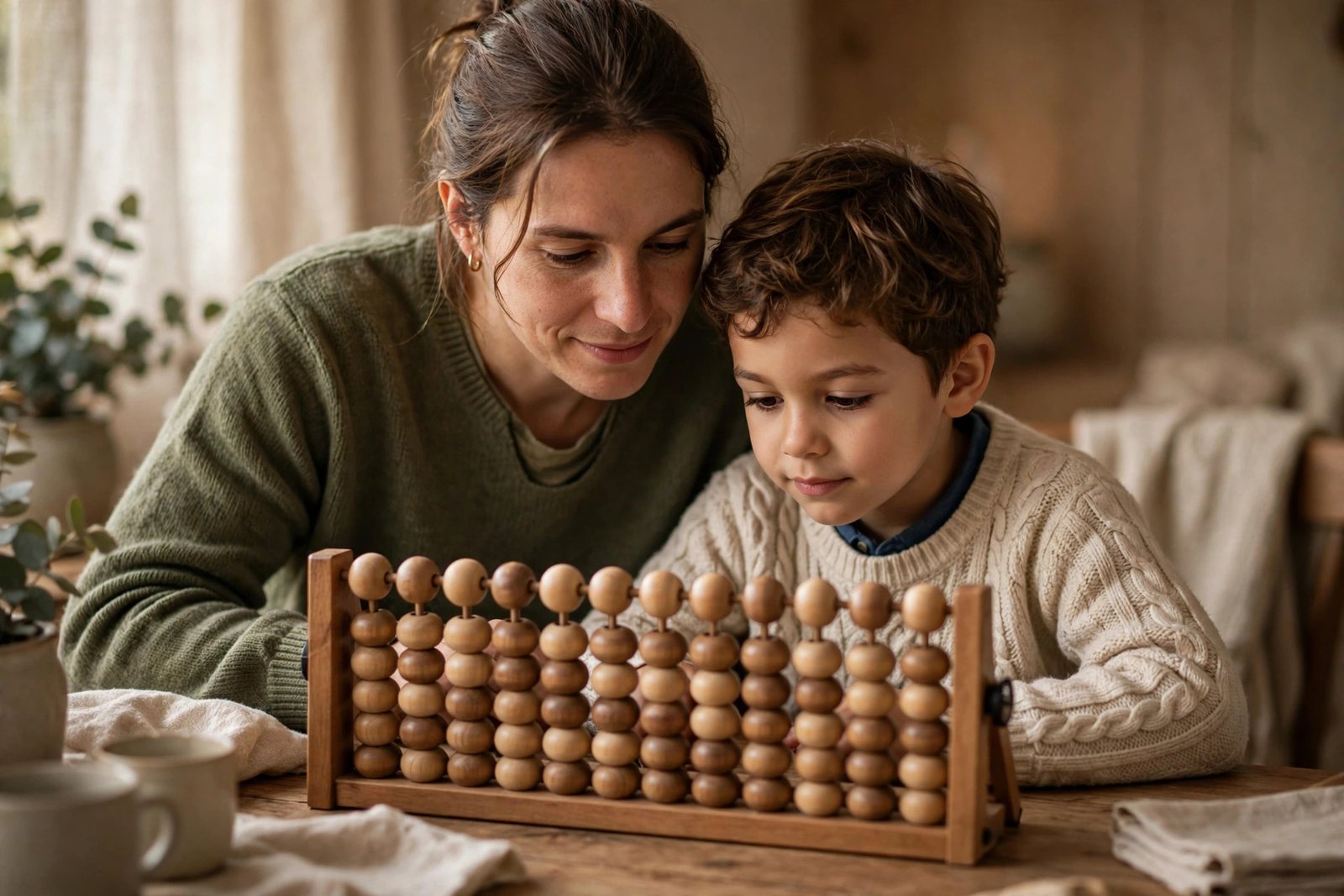
Before starting, it helps to explore the tool together with no teaching pressure at all. Our introduction to the parts of an abacus names each part in simple language you can share. Let your child slide beads, make patterns, and represent numbers from their everyday life, such as their age or the number of people at dinner.
Pacing, Sessions and Sensory Comfort
Keep sessions very short at first
Begin with sessions of just a few minutes and stop while things are still going well. You can always add a minute next week. A child who ends a session feeling successful will return more willingly than one pushed until frustration arrives. Build duration slowly, and let some days be play with beads rather than formal practice.
One new idea at a time is a good rule. Teach a single move, practise it in several gentle ways, and only move on when it feels familiar. Revisiting old skills is not going backwards. For children with learning difficulties, review is where security grows. The guidance in abacus finger technique can be introduced gradually too, without insisting on perfect form from day one.
Make the setting work for your child
Notice sensory details. Some children concentrate better with larger beads, a frame that does not slide, a quiet room, or a plain background behind the abacus. Others need to stand, move between short bursts, or hold a familiar object nearby. Adapt the setting freely. Comfort is not a reward for finishing. It is the condition that makes learning possible.
Choosing a Teacher and Talking to School
Teacher choice matters even more here than usual. Look for someone patient, observant and willing to slow down without making a child feel different. The advice in how to choose an abacus class applies, with extra questions added: How do you adapt pace? Can my child repeat a level without fuss? How will you tell me what is working?
Be open with the teacher about your child’s needs, strengths and any professional guidance you already follow. A good teacher will welcome that information and adjust group placement, instructions and expectations. If a class environment proves too fast or too noisy, individual lessons or learning at home with parental support may suit better, at least for a while.
Keep school in the picture too. Tell your child’s school teacher what you are trying, and ask whether they notice any change in confidence or number work. Abacus methods sometimes differ from school written methods, so clear communication prevents confusion. Most schools welcome any approach that helps a child engage with numbers more willingly.
Confidence, Motivation and Realistic Hope
Celebrate process milestones that other families might overlook: sitting for a full short session, remembering how to clear the beads, correcting a mistake independently, or explaining a number to you. For a child who has felt behind, these are significant achievements. The ideas in keeping your child motivated with abacus practice can be adapted, favouring private encouragement over charts that invite comparison.
Avoid comparing progress with siblings, classmates or level charts. Your child’s timeline is their own, and pressure is especially costly for learners who already expect to struggle. If abacus causes persistent distress despite gentle pacing and a kind teacher, it is fine to pause or stop. One tool does not suit every child, and choosing kindness over persistence is never the wrong call.
Hold realistic hope. Many children with learning difficulties do make genuine progress with numbers through patient, hands on practice, and the confidence gained often spreads into other schoolwork. Progress may be slower and may need more support, but slow progress is still progress, and a child who believes they can learn is already in a stronger place than before.
Keep each session short enough that your child finishes feeling capable rather than drained. A calm ending matters, because the feeling a child carries away from one session shapes how willingly they return for the next. If energy dips, pause, stretch, shake out busy fingers, and come back to one final easy row of beads. Ending on a success, even a small one, builds a quiet sense of progress that carries across the week.
Notice what helps your child most and write it down in a simple notebook. Some children like working in silence, some like a parent nearby reading, and some concentrate better after a snack or a short walk. There is no single right pattern. When you spot a pattern that works, repeat it gently for a few weeks before changing anything, because young learners settle when the shape of practice stays familiar.
Praise effort in specific words. Instead of a general well done, try naming what you saw, such as careful finger movement, checking an answer twice, or staying patient with a tricky row. Specific praise tells a child exactly what to repeat next time. It also keeps the focus on the process rather than on speed or comparison with anyone else, which protects confidence over the long term.
If a day goes badly, treat it as information rather than failure. Perhaps the sums were a step too hard, the room was noisy, or your child was simply tired. Adjust one thing, make the next session a little easier, and let success return. Children learn steadily when adults respond with curiosity instead of pressure, and a difficult day does not undo the good work already done.
Invite your child to explain a step back to you in their own words. Teaching, even for a minute, shows you what they truly understand and where a gentle correction might help. Keep your questions open and patient, and resist jumping in too quickly when they pause to think. That pause is often where the real learning is happening, as they picture the beads and work out the move for themselves.
Small, steady habits beat occasional long sessions. A few focused minutes on most days gives fingers repeated practice and keeps earlier skills warm while new ones are introduced. If you miss a day, simply begin again the next day without doubling the work or apologising for the gap. Consistency built kindly lasts far longer than a strict routine that makes everyone in the house feel tense.
Keep materials ready so starting is easy. When the abacus, pencils and practice sheets live in one predictable place, there is no hunting around and no lost momentum at the start of a session. Let your child help put things away neatly at the end, sliding the beads back to their resting position. That tiny closing ritual signals that practice is finished and the rest of the day can unfold.
Keep each session short enough that your child finishes feeling capable rather than drained. A calm ending matters, because the feeling a child carries away from one session shapes how willingly they return for the next. If energy dips, pause, stretch, shake out busy fingers, and come back to one final easy row of beads. Ending on a success, even a small one, builds a quiet sense of progress that carries across the week.
Notice what helps your child most and write it down in a simple notebook. Some children like working in silence, some like a parent nearby reading, and some concentrate better after a snack or a short walk. There is no single right pattern. When you spot a pattern that works, repeat it gently for a few weeks before changing anything, because young learners settle when the shape of practice stays familiar.
Praise effort in specific words. Instead of a general well done, try naming what you saw, such as careful finger movement, checking an answer twice, or staying patient with a tricky row. Specific praise tells a child exactly what to repeat next time. It also keeps the focus on the process rather than on speed or comparison with anyone else, which protects confidence over the long term.
If a day goes badly, treat it as information rather than failure. Perhaps the sums were a step too hard, the room was noisy, or your child was simply tired. Adjust one thing, make the next session a little easier, and let success return. Children learn steadily when adults respond with curiosity instead of pressure, and a difficult day does not undo the good work already done.
Invite your child to explain a step back to you in their own words. Teaching, even for a minute, shows you what they truly understand and where a gentle correction might help. Keep your questions open and patient, and resist jumping in too quickly when they pause to think. That pause is often where the real learning is happening, as they picture the beads and work out the move for themselves.
Conclusion
Every child learns in their own way and at their own pace, and the best decisions come from calm observation, honest questions and small steady steps. Use the ideas in this guide as a starting point, adapt them to your family, and keep talking with your child and their teacher as you go. With patience, encouragement and regular gentle practice, abacus can become a skill your child carries with confidence into school maths and everyday life.