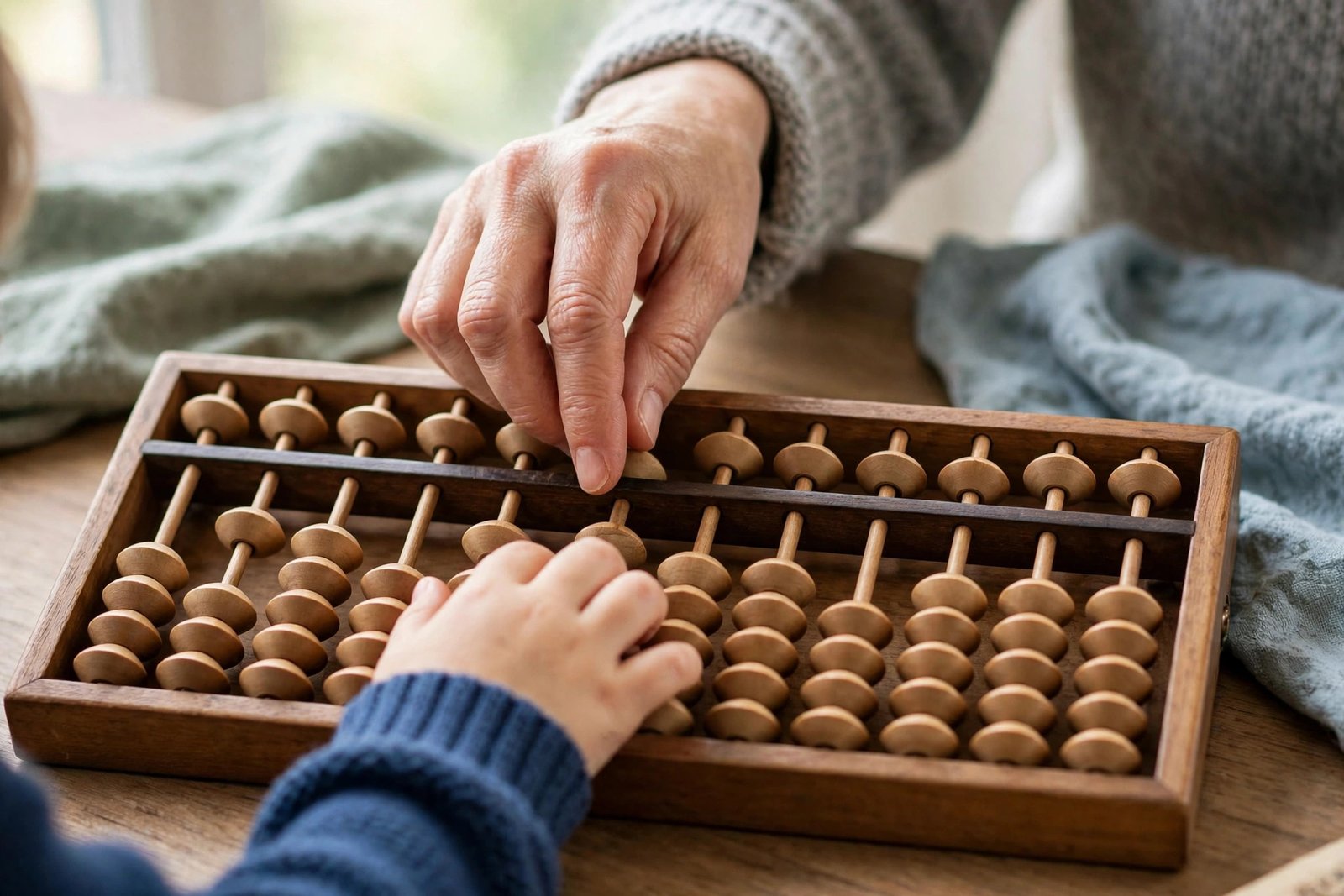
Addition on an abacus is where the frame stops being a curiosity and starts being a calculator your child controls. The first sums are wonderfully simple: set a number, move a few more beads, read the answer. From that easy start, teachers build step by step toward sums that need the clever five and ten groupings, and eventually toward fast mental addition without the frame at all. This beginner guide follows the same gentle order used in most classrooms, so parents and teachers can support practice at home without clashing with lessons.
Before starting, your child needs two foundations: knowing how numbers are shown with beads, and moving beads with the correct fingers. If either feels shaky, spend a few sessions there first. Our guide to the parts of an abacus explains bead values clearly, and the abacus finger technique guide covers thumb and index finger rules. Ten minutes of foundation saves hours of confusion later.
Before the First Sum: Clear, Set, Check
Every sum begins the same way. First, clear the frame so all rods show zero: upper beads pushed up away from the beam, lower beads pushed down. Second, set the starting number on the units rod, using the unit marker on the beam to find the right rod. Third, pause and read the number back to check it matches the question. This clear, set, check rhythm should become automatic. Most beginner errors are not addition errors at all; they are starting errors, where a leftover bead or a misread number spoils the sum before it begins.
For all the sums in this guide, work on the units rod only, with single-digit numbers. That is exactly where classes begin. Bigger numbers simply repeat the same ideas across more rods, and children meet them once the single-rod moves are secure.
Step One: Direct Addition with Lower Beads
Direct addition means the beads you need are free and waiting. Nothing clever is required: you just bring the beads to the beam.
Try two plus one. Clear the frame. Set two by lifting two lower beads to the beam with the thumb. Now add one: lift one more lower bead. Three lower beads touch the beam, so the answer is three. Read it aloud together. Then try one plus three, three plus one, and two plus two. All of these stay within the four lower beads, so they feel easy and build confidence fast.
A good teaching habit is to say the sum in a full sentence while working: “Two, add one, makes three.” Speaking the steps helps children connect the spoken numbers they hear in dictation practice with the moves their fingers make. Keep this stage playful. Quick oral questions, five sums in a row, and lots of praise for careful clearing and checking matter more than volume.
Step Two: Using the Five Bead
Soon a sum needs five or more on one rod, and the upper bead joins in. Remember, the upper bead pulled down to the beam is worth five, and numbers six to nine combine it with lower beads.
Try three plus three. Set three with three lower beads. Adding three more lower beads is impossible because only one lower bead remains free. Instead, teach the grouping children learn in class for this pattern: add five and take away two. Pull the upper bead down for five, and remove two lower beads. The rod now shows the upper bead plus one lower bead, which is six. The answer is correct, and your child has just used the five grouping, often called the small friend of the number being added.
Do not worry if that feels like a leap. Teachers introduce each small friend pairing one at a time with plenty of practice: the friend of one is four, of two is three, of three is two, and of four is one, all built around making five. At home, follow the order your child’s class uses and practise only the pairings already taught. The pattern to hold in mind as a parent is simple: when lower beads run out, think in fives.
Step Three: Adding Across a Ten
The next milestone is sums like seven plus five, where the units rod alone cannot hold the answer. Now the tens rod joins in, using the big friend groupings built around ten.
Try seven plus five. Set seven on the units rod: upper bead down, two lower beads up. To add five, use the ten grouping: add one ten and take away five from the units rod. Lift one lower bead on the tens rod to show one ten. On the units rod, remove the upper bead, the five. The frame now shows one ten and two ones: twelve. Your child has carried into the tens exactly as written maths does, but with beads that make the exchange visible.
Again, classes teach these big friend steps gradually, one pairing at a time, and children practise each until it is automatic. Parents do not need to race ahead. Your role is to provide calm repetition of the steps your child already knows, and to celebrate the moment carrying stops feeling strange. That moment always comes with practice.
Step Four: Two-Digit Addition on the Frame
Once carrying makes sense, two-digit sums open up. The method mirrors the single-digit one, rod by rod. Set the first number across the units and tens rods. Then add the second number in parts: add its tens to the tens rod, then its ones to the units rod, using direct moves, five groupings, or ten groupings whenever a rod needs them.
Try twenty-three plus fourteen. Set twenty-three: two lower beads on the tens rod, three on the units rod. Add one ten by lifting one more bead on the tens rod, giving three tens. Add four ones: only one lower bead is free on the units rod, so use the five grouping, add five and remove one. The units rod shows the upper bead plus two lower beads, seven. Read the frame: thirty-seven. Worked slowly and checked rod by rod, sums like this feel very manageable. When your child is ready to stretch further, our guide to two-digit numbers on the abacus gives more structured practice in this direction.
Teaching Tips That Make Practice Work
Little and Often
Short daily practice beats long weekly sessions for beginners. Ten relaxed minutes keeps finger habits fresh without tiring a young child. End each session with one sum your child can definitely do, so practice closes with success.
Read Every Answer Back
Insist on reading the finished frame aloud before writing the answer down. Reading back catches misplaced beads while they can still be fixed, and it builds the bead-picture recognition that mental maths later depends on.
Mistakes Are Information
When an answer is wrong, redo the sum slowly together and find the step that slipped. Was the frame cleared? Was the first number set correctly? Did the right finger move? Treating errors as clues keeps children calm and turns correction into learning rather than scolding.
A Sample Ten-Minute Home Practice Session
Here is a simple session structure parents can reuse on most days. In the first two minutes, your child clears the frame and runs through bead ladders on the units rod, showing every digit from zero to nine and back again to warm up the fingers. In the next three minutes, work on direct addition only: call out five or six sums such as two plus one, one plus three, and four plus five with the five bead, letting your child set, add, and read back each answer before you confirm it. In the following three minutes, practise only the newest step your child has learned in class, whether that is one small friend pairing or one big friend carrying pattern, using the teacher’s exact wording. Finish with two minutes of easy wins: sums your child already finds simple, done at a comfortable speed, so the session ends with confidence rather than fatigue.
Keep a small notebook of the sums practised and any step that caused hesitation. Patterns appear quickly: a child may handle direct addition perfectly yet hesitate on one particular pairing, and that tells you exactly where the next session should focus. Share the notebook with the teacher at the next class. Teachers value this kind of specific feedback far more than a general report that practice went well or badly, because it lets them target class time where it helps most.
Using Spoken Dictation
Once frame addition is steady, add listening work. Call out a short chain such as “three, add two, add four,” pausing between numbers, and let your child work on the frame without writing anything until the end. Dictation trains the listening and memory skills that mental maths depends on, and children usually enjoy the game-like feel of keeping up with a calm, steady voice. Start with chains of three numbers and grow only when accuracy stays high.
What Comes After Addition?
Addition is the gateway skill. The same bead fluency flows directly into the mirror skill covered in our guide to subtraction on the abacus for beginners, and later into multiplication, division, and fast mental work across all four operations. Children who add confidently, with clean technique and honest checking, almost always find each new operation easier to accept, because the frame itself no longer demands any of their attention. All their thinking can go to the new idea.
Parents sometimes ask how long this stage lasts. It varies with age and practice, but the pattern is consistent: direct addition becomes quick within weeks, five groupings take a little longer, and ten groupings need patient repetition before they feel easy. Steady, cheerful practice gets every child there. Comparing your child with a classmate gets nobody there faster.
Conclusion
Teaching addition on the abacus works best in the classroom order: clear and set carefully, master direct addition with the lower beads, bring in the five bead when beads run out, then carry across a ten, and finally combine the steps for two-digit sums. Support each stage with short daily practice, read every answer back from the frame, and treat mistakes as clues. Follow that path and your beginner will build addition skills that are accurate, understood, and ready to grow into full mental maths.



6 thoughts on “Teaching Addition on an Abacus: A Step-by-Step Beginner Guide”