
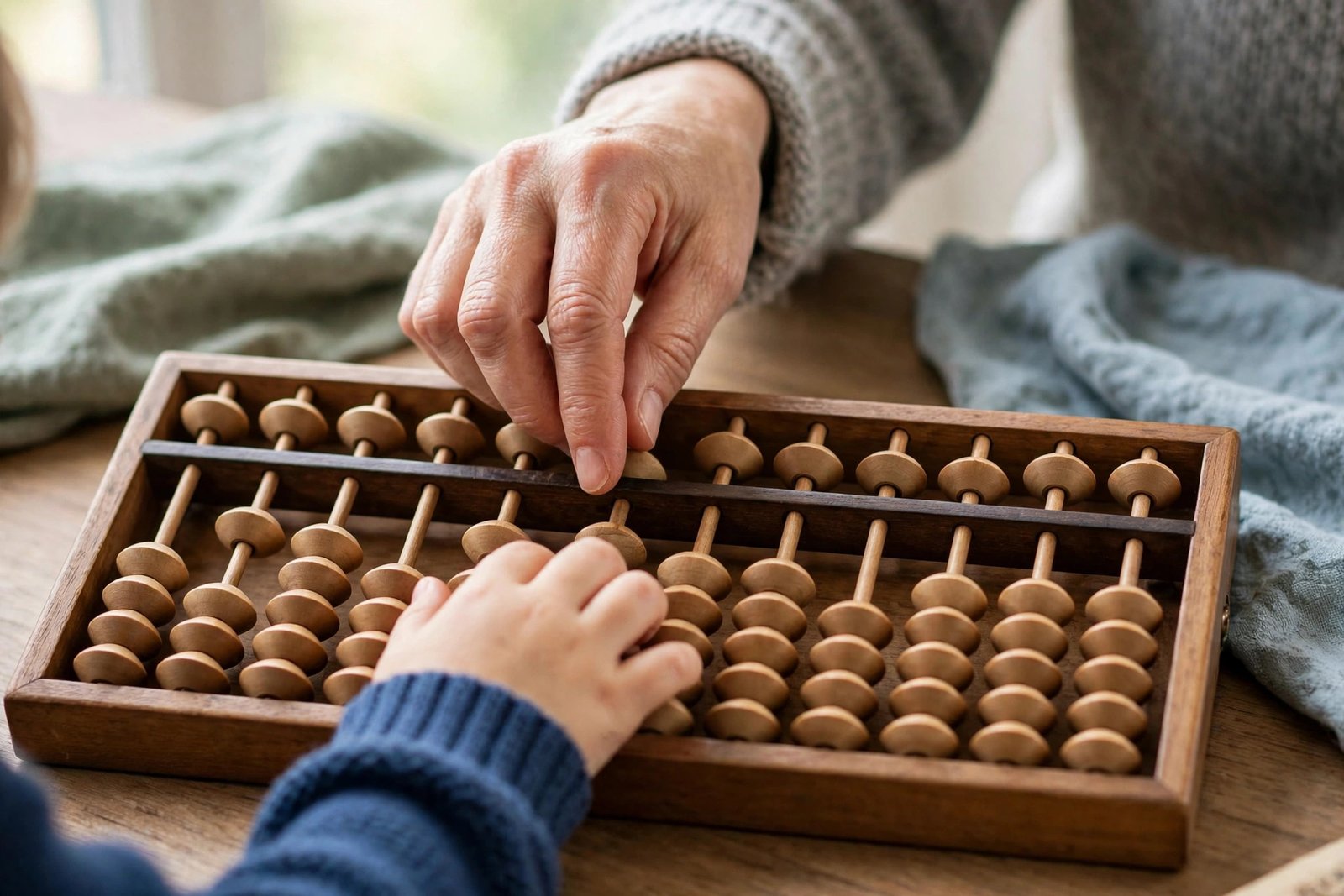
Subtraction can feel tricky for young children when it only lives on paper. Numbers disappear, answers feel abstract, and borrowing looks like a rule to memorise rather than something that makes sense. The abacus changes that experience completely. When a child does subtraction on an abacus, taking away becomes something they can see and touch. Beads move away from the centre bar, a number gets smaller in front of their eyes, and the idea of less starts to feel clear and physical.
For parents and teachers, the abacus offers a patient way to teach subtraction without rushing into written methods. A child can set a number, physically remove beads, and read the answer that remains. There is no guessing and no hidden step. If the answer looks wrong, you can both look at the same beads and work out together what happened. That shared, visible process builds understanding first, and speed comes later with practice.
This guide walks through subtraction on the abacus in simple stages, from taking away one or two beads to handling larger numbers that need a little extra thinking. You do not need to be a maths expert to use it. You only need a standard abacus, a few minutes at a time, and a calm approach that lets your child explore, make mistakes, and try again.
What Your Child Needs to Know Before Subtraction
Subtraction goes much more smoothly when a few basics are already in place. First, your child should be able to set simple numbers on the abacus and read them back. That means knowing that each column stands for a place, with units on the right, then tens, then hundreds, and knowing how the lower beads and the single upper bead work together to show values from zero to nine.
Second, a little experience with addition helps a lot. Children who have already practised addition on the abacus for beginners understand how beads move toward the bar to show a number. Subtraction simply reverses that movement. When a child sees addition and subtraction as opposite actions on the same tool, both operations become easier to remember.
Setting Up the Abacus for a Subtraction Problem
Every subtraction starts with a clean frame. Show your child how to clear the abacus by moving all lower beads down and all upper beads up, away from the centre bar, so every column shows zero. A simple sweep with two fingers across the frame can become a small ritual that signals a new question is starting. Children enjoy that reset moment, and it prevents leftover beads from an earlier problem causing confusion.
Next, set the larger number, the number you are subtracting from. Work column by column from left to right, or from units upward if your child prefers, but be consistent. Ask your child to read the number aloud once it is set. That quick check catches setting errors early, before any beads are taken away. Only then introduce the second number, the amount to take away, and say the full question out loud together, for example seven take away three.
The Basic Move: Taking Beads Away Directly
The simplest form of subtraction on the abacus is direct taking away. If a column has enough beads already active to cover the amount being removed, your child simply moves that many beads away from the bar. For example, to work out seven minus three, set seven on the units column with the upper bead down for five and two lower beads up. Then move three beads away, and four beads remain active. Your child reads four as the answer.
Practise this direct method with lots of small examples before moving on. Stay within numbers your child can set confidently, and mix the questions so the pattern is not predictable. Ask for eight minus two, six minus four, nine minus five, and similar single column problems. Each time, encourage your child to say what they are doing as they move the beads. Talking through the move slows the hands just enough to prevent rushing and helps the brain connect the action to the number sentence.
Once single column direct subtraction feels easy, extend the same idea across columns. A question like forty eight minus twenty three is really two small subtractions side by side, tens first or units first depending on your teaching approach. Show your child that the abacus handles each column separately, and that the answer is read across the whole frame at the end. That realisation removes much of the fear children feel when they first see two digit subtraction on paper.
A Simple Routine for Each Question
A steady routine helps beginners more than any clever trick. Try this order every time: clear the frame, set the first number, read it aloud, say the take away amount, move the beads slowly, read the answer aloud, and finally check the answer by adding it back. That last check is powerful. If the answer plus the amount taken away gives back the starting number, the work is correct. Children love catching their own mistakes this way because it feels like solving a puzzle rather than being corrected.
Keep sessions short at this stage. Ten focused questions done carefully teach more than thirty rushed ones. End while your child still feels successful, and note which types of questions felt easy and which needed help. That small note guides what you practise next time without any pressure or testing atmosphere.
When There Are Not Enough Beads: A Gentle Introduction
Sooner or later your child will meet a question where a column does not have enough active beads for a direct take away. For example, in thirteen minus seven, the units column shows three, and you cannot directly remove seven from three active beads. On paper this is where borrowing appears. On the abacus, the solution is friendly and visual: you use the neighbouring column and a complement idea.
At beginner level, you do not need to name every rule on day one. You can simply show the exchange. Take one ten from the tens column, which adds ten to the units side in value, then take away seven, and read what remains. Many structured programmes teach this through the friend numbers system, which is explained in our guide to abacus complements and friend numbers. For now, let your child see that the total value stays fair: nothing is lost, the beads are just rearranged so the subtraction becomes possible.
Introduce these questions one at a time, with plenty of support. Work the first few together, talking through each exchange. Then let your child try one while you watch quietly, and only step in if they ask or get truly stuck. Confidence grows fastest when children feel the success belongs to them, even when the question is harder.
Working With Two Digit and Three Digit Subtraction
Once direct subtraction and simple exchanges feel comfortable, your child can tackle larger numbers in a calm, column by column way. Set the starting number across the units, tens, and hundreds columns. Then subtract each part of the second number in turn. Some teachers work from left to right to match how numbers are read, while others start with the units. Either approach can work well as long as it is consistent and your child understands what each column represents.
A worked example helps. For ninety six minus forty seven, set ninety six. In the tens column, taking away four tens from nine tens is direct and leaves five tens. In the units column, taking away seven from six needs an exchange, so one ten is traded across, the units become sixteen in value, seven is removed, and nine remains. The frame now shows forty nine. Reading that process slowly, column by column, shows your child that a problem which looks big on paper is really a series of small, manageable moves.
Connecting Bead Subtraction to Everyday Maths
Children learn best when a new skill connects to things they already care about. Use subtraction language during the day whenever it appears naturally. If there were ten grapes and four have been eaten, ask how many are left, and later work the same numbers on the abacus. If a story has twelve pages and your child has read five, the remaining pages become a real subtraction question with a reason to care about the answer.
This is also where the link to place value deepens. Our guide on carrying and borrowing on the abacus shows how exchanges between columns mirror the written methods used in classrooms. When children understand why an exchange works on the beads, the paper method stops being a mysterious rule and becomes the same idea written down.
Common Difficulties and How to Help
Almost every beginner makes the same handful of slips, and none of them mean your child is bad at maths. One frequent slip is moving beads toward the bar instead of away during subtraction, especially when switching quickly between addition and subtraction questions. A simple fix is to practise in blocks: a set of addition questions, a pause, then a set of subtraction questions, so the direction of movement settles in the mind.
Another common difficulty is forgetting to clear the frame between questions, which leaves stray beads that corrupt the next answer. Making the clearing sweep part of the routine, almost like a game gesture, solves this quickly. A third slip is reading the final frame too fast and misreading a column where the upper bead is involved. Slowing down the final read, column by column from left to right, fixes most of these errors.
Building a Short Daily Practice Habit
Regular short practice beats occasional long sessions for almost every child. Ten to fifteen minutes a day is plenty at beginner level. Start with two or three warm up questions your child finds easy, move to a handful of questions at their current level, and finish with one question they can explain to you like a teacher. Teaching back is a wonderful test of understanding and most children enjoy the role reversal.
If you want a ready made structure, our daily abacus practice routine lays out a simple weekly rhythm you can adapt. Keep the abacus somewhere visible and easy to reach, not packed away in a cupboard, because small barriers quietly kill habits. A practice corner, a small notebook for scores if your child likes tracking, and a consistent time of day all help the routine stick.
Above all, keep the tone light. Subtraction on the abacus is a skill that grows steadily with calm repetition. Some days will feel effortless and some days will feel slow, and both are normal parts of learning. Your steady encouragement matters more than any single session.
Conclusion
Subtraction on the abacus turns an abstract idea into a clear, hands on action that children can see, check, and understand. Start with direct taking away, add exchanges gently when they are needed, and build toward larger numbers column by column at your child’s pace. With short daily practice, honest checking, and plenty of patience, your child will move from moving beads carefully to picturing those beads in their mind, and subtraction will become a skill they trust rather than a topic they fear.


One thought on “Teaching Subtraction on an Abacus: Simple Steps for Kids”