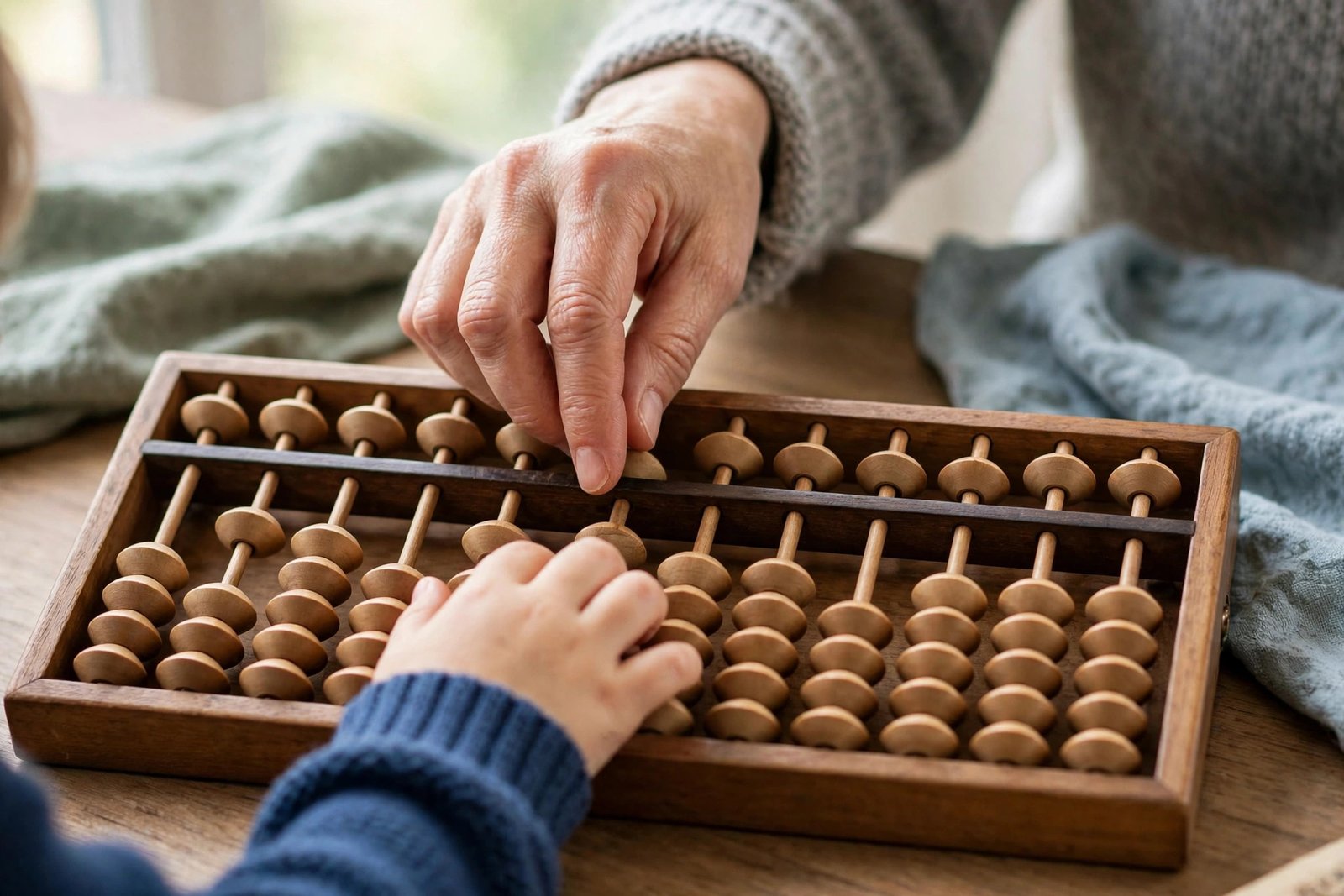
Carrying and borrowing are the two ideas that make many children nervous about written maths. A small number appears above the column, digits get crossed out, and the whole problem suddenly looks messy. Parents remember their own confusion and worry about passing it on. The abacus offers a calmer way into the same ideas, because on the beads there is nothing hidden and nothing crossed out. Value simply moves from one column to the next, in full view.
When a column fills up on the abacus, the extra value travels left as a ten. When a column does not have enough to give, value travels right from the next column to help. Those two journeys are carrying and borrowing. Children who learn them on the beads first often understand the paper methods better afterwards, because they have watched the exchange happen with their own hands.
This guide explains both ideas step by step, with worked examples you can copy at home. It keeps the language simple, shows where children usually stumble, and offers gentle ways to practise until exchanges between columns feel ordinary rather than alarming.
Why Columns Exchange Value at All
Before the moves make sense, the reason behind them needs to feel obvious. Each abacus column can show any value from zero to nine, and no more. Ten in one column is not allowed to stay there, because our number system groups ten ones into one ten, ten tens into one hundred, and so on. That grouping rule is place value, and it is the engine behind both carrying and borrowing.
Use everyday grouping to make the rule feel natural. Ten loose pencils become one bundle. Ten single coins of the smallest value become one larger coin. Children accept these exchanges instantly in real life. The abacus simply applies the same fairness: whenever a column collects ten, those ten are traded for one bead in the next column, and whenever a column needs more, one bead from the next column is traded back into ten smaller units.
If your child is still getting comfortable with larger numbers, spend time with two digit numbers on the abacus first. Fluent setting and reading across two columns frees up attention for the exchange itself, which is where the new thinking happens.
Carrying in Addition: When a Column Overflows
Carrying happens during addition when a column’s total reaches ten or more. The steps never change: add what fits in the column, trade ten of that column for one in the next column, and keep the remainder where it is. On the beads, children usually learn the shortcut form using big friend numbers: add one to the next column and remove the complement of the number being added from the current column. Both descriptions lead to the same beads.
Work through twenty seven plus fifteen together. Set twenty seven. Add one ten directly to the tens column, making three tens so far in value. Now add five to the units. Seven plus five would be twelve, which overflows, so carry one ten into the tens column and leave two in the units. The frame shows four tens and two units: forty two. Point out to your child that the carried ten is not extra value appearing from nowhere. It is ten of the twelve units, repackaged.
Try a second example with larger numbers, such as sixty eight plus forty five. The units overflow, the tens then overflow as well after receiving the carried ten, and a new hundred appears. Double carries look dramatic but follow the same single rule applied twice. Work slowly, one column at a time, and read the growing answer after each stage so your child sees the number building rather than magically appearing at the end.
Helping Your Child Spot a Carry Before It Happens
Fluent learners do not stumble into carries; they expect them. Teach your child a quick prediction habit. Before adding in a column, glance at the two digits and ask, will this make ten or more? If the digits add to nine or less, no carry is coming and the move is direct or needs only a small friend. If they reach ten or beyond, a carry is certain, and the child can prepare the exchange calmly instead of discovering a blocked column mid move.
That prediction habit also bridges beautifully to school maths, where estimating whether an answer should grow into the next place helps children sanity check their written work. Prediction, then action, then a quick glance to confirm: that rhythm is worth building from the very first carrying lesson.
Borrowing in Subtraction: When a Column Cannot Give
Borrowing is the mirror image of carrying. It happens during subtraction when the digit being taken away is larger than what the column currently shows. The fix is an exchange in the opposite direction: one bead from the next column is traded into ten in the current column, the subtraction becomes possible, and the neighbouring column is left one smaller.
Work through fifty two minus twenty eight. Set fifty two. The tens subtract directly at first glance, but many teachers handle units first, so begin there. Two units cannot give eight, so borrow one ten. The tens drop from five to four in effect as the exchange completes, the units become twelve in value, and eight is removed leaving four. Now subtract two tens from the remaining four tens, leaving two tens. The frame shows twenty four. Ask your child to check by adding twenty four and twenty eight back together on the beads. Reaching fifty two proves the borrowing was fair.
The language matters here. Some children dislike the word borrow because nothing is ever given back. If that bothers your child, use exchange, trade, or break a ten instead. The bead action is identical, and a word that makes sense to your child will always beat a traditional word that confuses them. Many modern classrooms have made the same shift for the same reason.
The exchange relies on the big friend pairs, so if borrowing feels shaky, revisit small friend and big friend numbers for a session or two. Borrowing is really just a big friend move wearing a subtraction costume, and children relax when they recognise an old friend inside a new problem.
The Tricky Case: Borrowing Across Zero
Every learner eventually meets a number like one hundred and three minus forty six, where the tens column is empty and there is no ten to borrow directly. On paper this produces the famous cascade of crossings out. On the abacus, handle it as two honest trades. First trade one hundred for ten tens. Then trade one of those tens for ten units. Now the subtraction can proceed, and the frame still shows exactly the same starting value, just arranged more usefully.
Introduce this case late, only when ordinary borrowing is secure, and teach it as a special event worth slowing down for. Let your child perform both trades and then read the rearranged number aloud before subtracting anything. If they can say, this is still one hundred and three, shown a different way, they understand the heart of the method and the rest is routine bead work.
Resist the temptation to drill this case repeatedly in one sitting. A few careful examples across several days settle the idea far better than a long page of zeros on day one. Children remember what they understood calmly much longer than what they survived anxiously.
Carrying and Borrowing in Longer Calculations
Real calculations rarely stop at two digits. The good news is that nothing new is invented for three or four digit problems. Each column is handled in turn, exchanges travel only between neighbouring columns, and the same prediction and checking habits apply. A long addition is simply a row of small additions, some of which carry. A long subtraction is a row of small subtractions, some of which borrow.
Teach your child to work in a fixed direction and never skip around the frame. Most abacus programmes work from left to right, which matches reading order and makes mental calculation easier later, since answers begin forming from the most important digit. Whichever direction your child’s class uses, consistency matters more than the choice itself. Switching direction mid problem is a reliable recipe for a lost carry.
Keep a finger or a marker under the column being worked on during long problems. It sounds trivial, but many errors in longer work are simply place errors, where a correct move happens in the wrong column. Our roundup of common abacus mistakes beginners make covers this and other frequent slips, along with kind fixes for each.
Connecting Bead Exchanges to School Methods
Parents often ask whether abacus carrying and borrowing will clash with what school teaches. The concepts are the same; only the recording differs. On paper, a carried ten is written as a small digit above the next column. On the abacus, that same ten is a bead actually moved. In written borrowing, digits are crossed out and rewritten. On the abacus, the exchange is performed instead of annotated. Children who have performed an exchange many times usually find the written shorthand easy to accept, because they know what the shorthand stands for.
If homework uses unfamiliar language, sit with your child and translate one example together, bead version first, paper version second. That small bridging exercise, repeated a few times, prevents the two methods from feeling like rival systems. Your child gains one understanding with two ways of writing it, which is a genuine advantage in the classroom.
For a refresher on the operations themselves, revisit addition on the abacus for beginners alongside subtraction practice, mixing a few carrying questions into otherwise easy sets so the exchange skill stays warm without dominating every session.
Gentle Practice Ideas That Build Confidence
Practise exchanges in small, targeted doses. One useful set focuses only on prediction: show ten quick column pairs and let your child say carry or no carry without touching the beads. Another set isolates the exchange itself, using numbers chosen so every question carries once. A third set mixes everything, mirroring real calculations. Rotating these three set types across a week gives variety without randomness.
Games help too. A simple race against a personal best time, a treasure hunt where each correct exchange earns a clue, or a parent versus child challenge with the parent using paper while the child uses beads all keep energy high. Keep competition kind and optional. The learning lives in the careful exchanges, not in the winning.
Always finish with the checking habit. Adding back after a subtraction and estimating before an addition turn your child into their own first marker. That independence is the real prize of this stage, because a child who can verify their own exchanges no longer needs an adult hovering over every answer.
Conclusion
Carrying and borrowing on the abacus are simple, honest trades: ten in one column become one in the next, and one in the next column can break back into ten. Teach the reason before the routine, predict exchanges before making them, and handle the borrowing across zero case slowly when it arrives. Practised this way, the two ideas that trouble so many children on paper become some of the clearest and most satisfying moves in all of abacus learning.