
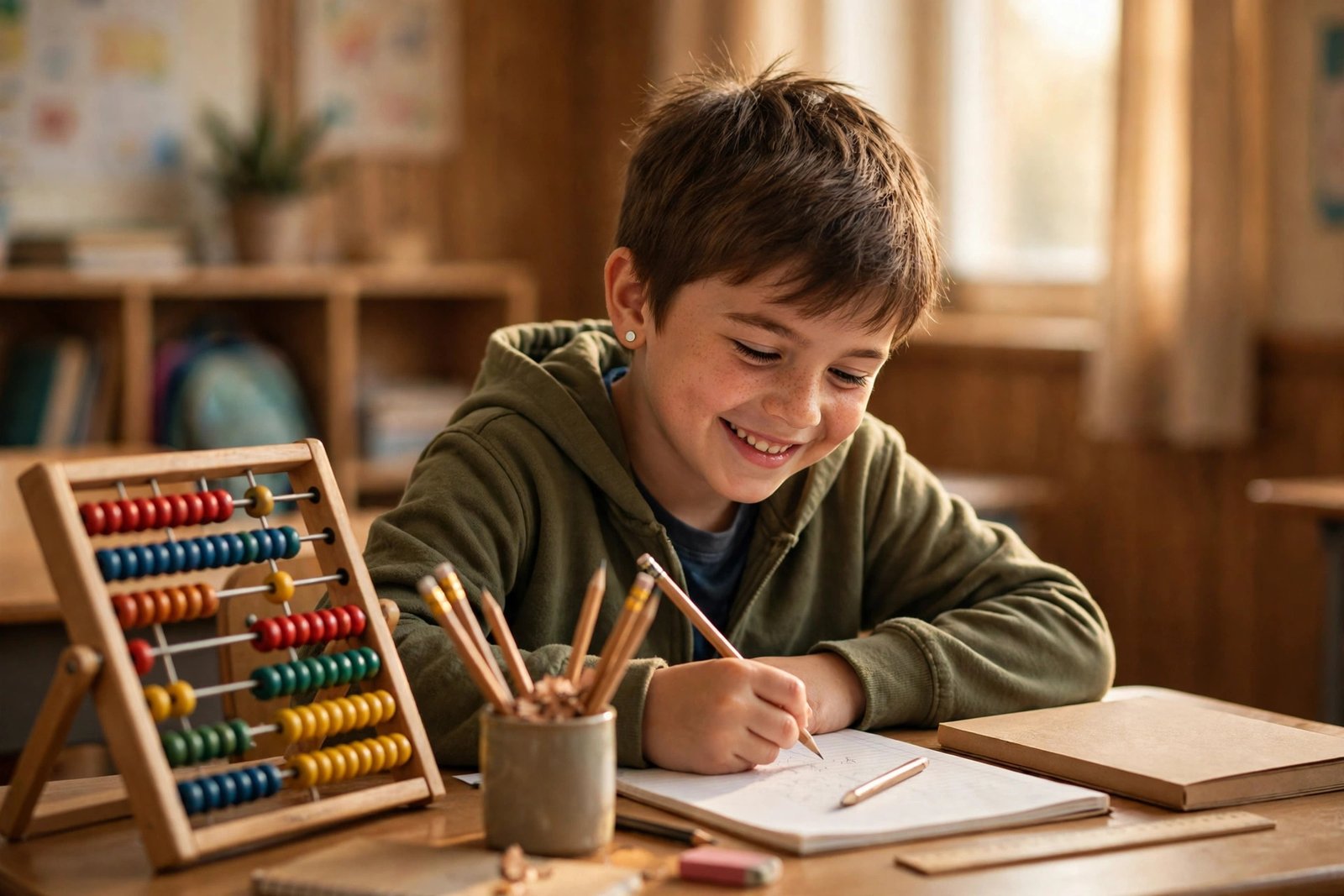
Watch a child who has trained with an abacus for a while and something interesting happens during mental work. Their fingers may twitch slightly in the air, as if moving beads that are not there. They are not pretending. In their mind, a picture of the frame is present, and they are moving imagined beads on imagined rods to work out the answer. This is the heart of abacus mental maths. The physical tool teaches a method so clearly that, with practice, the tool itself can be left behind while the method stays, carried as a mental image that the child can use anywhere.
This transition does not happen by accident, and it does not happen all at once. It is built deliberately, in stages, alongside ordinary bead practice. Understanding how visualisation develops helps parents support it at home, recognise genuine progress, and avoid the common mistake of removing the physical abacus too early in the hope of forcing mental skill. The image in the mind grows out of hundreds of real movements. The more accurate those real movements are, the clearer the picture becomes, and the faster and more reliable the mental calculation that follows from it.
Why a Picture Is Easier to Calculate With Than Words
Many children first meet mental arithmetic as a string of spoken steps held in memory. Remember the first number, add the tens, hold that result, add the ones, remember to carry. That is a lot to hold in words, and one distraction can lose the whole chain. A pictured abacus works differently. The current total is not a sentence to remember. It is a pattern of beads that simply sits there in the mind, stable while the next step is applied. Each move updates the picture. For many children, holding a picture feels lighter than holding a list, which is why the method can produce both speed and calm.
This does not mean words disappear. Beginners often talk themselves through visualised moves, quietly naming each step while picturing it. Over time the narration fades and the picture does the work alone. Parents may notice a child answering before they could possibly have recited the steps, and that is a good sign. The calculation has become visual rather than verbal. It also explains why children trained this way sometimes struggle to explain their working in words at school. Their method is real, but it lives in pictures, and translating it into spoken steps is a separate skill worth practising too.
Stage One: A Rock-Solid Physical Method
Visualisation begins on the real frame. A child cannot picture beads moving correctly if their hands do not yet move them correctly. So the first stage is ordinary, careful bead work. Setting numbers cleanly, using the right fingers, following the same order of steps, and checking answers until the routine is automatic. Work such as addition on the abacus for beginners may look basic, but it is laying down the exact movements that will later be imagined. Rushing this stage produces a fuzzy mental picture later, and fuzzy pictures produce unreliable answers.
Teachers often encourage children to look at the frame while they work, rather than at their fingers. This small habit matters more than it seems. The eyes record the bead patterns for each number, the look of five, the look of eight, the look of a rod after a carry. Those patterns become the vocabulary of the mental image. A child who has seen a completed sum clearly, many times, can later recall what a correct intermediate stage should look like and spot when their imagined frame looks wrong. That self-checking ability is one of the quiet strengths of the whole approach.
Stage Two: Picturing Small Numbers With Eyes Open, Then Closed
The first visualisation exercises are tiny. A teacher sets a single-digit number on the frame, lets the child look, then covers the frame or asks the child to close their eyes and say what the beads looked like. Then the child imagines moving one bead and describes the new picture. Only when single rods can be pictured clearly do exercises grow to two rods, then to short additions. This gradual widening mirrors how the skill began on the real frame, one rod at a time, and it keeps the success rate high so that children trust the process.
At home, you can support this stage with gentle games. Set a number, give your child a good look, then cover it and ask them to set the same number on an empty part of the frame or draw the bead pattern. Flash a number briefly and ask what it was. Keep these games short and playful, and stop while they are still fun. The goal is a clear picture, not endurance. If your child finds eyes-closed work hard at first, that is completely normal. Visualisation is a skill like any other, and it strengthens with brief, regular attempts rather than long, frustrating ones.
The Role of Finger Movements in the Air
Many children move their fingers while visualising, as though working a tiny invisible abacus on the desk or in the air. This is not a bad habit to correct. The movements anchor the picture and pace the calculation, in the same way that tapping a rhythm helps a musician keep time. Over months, the movements usually become smaller and may disappear entirely, but there is no need to hurry that process. Some experienced calculators keep a slight finger motion for difficult sums throughout their training. What matters is the accuracy of the pictured beads, not whether the hands are perfectly still.
Stage Three: Mental Addition and Subtraction Chains
Once two or three rods can be pictured reliably, children begin true mental calculation. They hear or read a sum, picture the first number, and apply each following step to the image. Early mental work sticks to numbers and techniques already mastered on the frame, so the only new demand is holding the picture. Dictation exercises are central here. A teacher or parent reads numbers at a steady pace, and the child updates the imagined frame after each one, giving only the final answer. Starting slowly, with generous pauses, and quickening gradually as accuracy holds, builds both speed and composure.
The mental addition patterns children use are the same complement methods learned with real beads, which is why mental addition tricks for kids from abacus training feel so natural to them. Adding nine by adding ten and removing one is no longer a written rule. It is a picture of a bead moving on the next rod while one bead drops away. Because the moves are visual and few, chains of several numbers become manageable. A child who can add a column of prices or scores mentally is using exactly this pictured method, step by steady step.
How Speed Actually Develops
Speed in this system is a side effect of clarity, not a separate talent. When bead patterns are recognised instantly, no time is spent decoding them. When the next move is chosen without hesitation, no time is lost deciding. When the picture is stable, no time is spent rebuilding it after a wobble. Timed practice helps by encouraging children to trust what they know, but timing a child whose picture is still fuzzy mainly teaches rushing. Good programmes therefore build accuracy first at each new size of problem, then add gentle time pressure, then increase the size again. Parents see this as plateaus followed by sudden jumps, which is a normal shape for this kind of learning.
Comparing speeds between children is rarely helpful. Children differ in how vividly they picture things, how quickly their fingers learned the original movements, and how much practice they do. The fair comparison is with the child’s own past performance. Keeping a simple note of what they could do a month ago, inside a steady daily abacus practice routine, makes progress visible even during a plateau. Often the improvement is happening in accuracy or in the size of number handled, while raw speed waits to catch up, and all three are real gains worth naming.
What Can Slow Visualisation Down
A few obstacles appear often. The first is gaps in the physical method. If carrying on the real frame still needs thought, the mental version will stall at the same place, so the fix is to return to the beads without embarrassment. The second is practice that is too irregular for the picture to stay sharp between sessions. Short, frequent practice protects the image far better than rare long sessions. The third is anxiety about speed, which makes children abandon their picture and guess. Slowing the pace of dictation, praising careful answers, and keeping timed work light-hearted usually restores confidence.
Distraction plays a part too, because holding a picture requires attention. Interestingly, the practice itself trains that attention. Children must keep the image steady while new numbers arrive, which is focused work for the mind, and many parents report that this carries into other tasks. The connection is explored further in how abacus practice improves concentration. At home, a quiet corner and a predictable routine give visualisation its best chance, which is why setting up a small practice space is worth the little effort it takes.
Supporting the Journey at Home
Your main role is to provide regular chances to practise and to keep the tone relaxed. Read out short dictation sets at a pace your child can handle. Play shopping and scoring games where totals are kept mentally, with the frame nearby for checking rather than as a first resort. Ask your child to teach you a mental trick they have learned, because explaining a picture to someone else sharpens it. And when mental work goes wrong, treat the physical abacus as a friendly backup, not a step backwards. Checking a failed mental sum on the beads shows exactly where the picture slipped, and that information is how the picture gets stronger.
Conclusion
The path from beads to mental maths runs through visualisation. A solid physical method gives the mind accurate movements to copy, graded picture exercises turn those movements into a clear inner frame, and steady mental practice makes that frame faster and more reliable. Speed arrives as a result of clarity and trust, not from rushing or removing the real abacus too soon. Support the stages in order, keep practice short and regular, and let your child return to the beads whenever a picture wobbles. Done this way, the abacus eventually becomes unnecessary for everyday sums, because your child carries it with them.


4 thoughts on “From Beads to Mental Maths: How Visualisation Builds Speed”