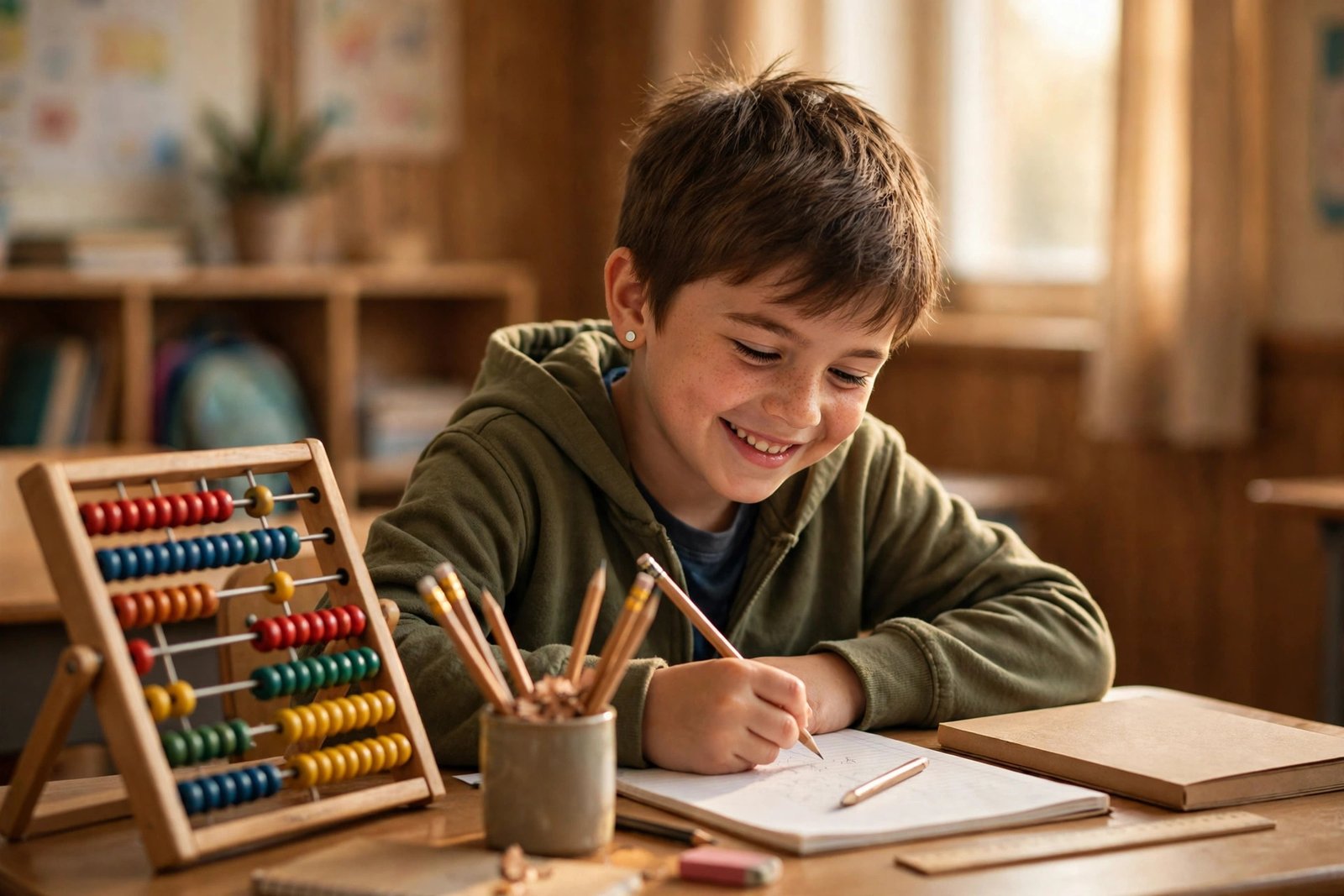
Many parents first hear about the abacus as a way to calculate quickly. Speed is part of the story, but it is not the whole story. The skills a child builds while moving beads, picturing numbers, and working through steps in an orderly way show up in many places: in the classroom, in homework, in shops, and in everyday conversations about time, money, and measurement.
This article explains, in practical terms, how abacus helps in school maths and in daily life. It does not promise instant results or overnight transformation. Abacus learning is gradual, and its benefits grow with regular practice. But when a child understands numbers more deeply and feels calmer facing them, teachers and parents often notice the difference across a whole range of tasks, not just in timed calculations.
If your child is just beginning, the effects may start small: counting more carefully, lining up numbers correctly, or checking an answer instead of guessing. Over months, those small habits can become a strong foundation that supports almost everything else in maths.
A Stronger Sense of What Numbers Really Mean
School maths moves quickly from counting objects to working with symbols on a page. For some children, that jump is where confusion begins. A number like 47 is just two digits until a child understands that it means four groups of ten and seven ones. On an abacus, that idea is visible. The tens sit in one column, the ones in another, and a child moves each part separately.
Working with two-digit numbers on the abacus gives children repeated, hands-on experience of this structure. They build a number, change it, add to it, and take away from it, watching the columns respond. When the same numbers later appear in a textbook, the child has a picture in mind rather than only a rule to remember.
This number sense helps with estimation too. A child who understands the size of numbers can tell whether an answer looks sensible. If a sum involving two numbers under a hundred produces an answer in the thousands, something is wrong, and a child with good number sense is more likely to pause and check. That checking habit is one of the most valuable things any young mathematician can develop.
Addition and Subtraction That Feel Less Like Guesswork
Addition and subtraction are the workhorses of primary school maths. They appear in almost every topic, from money to measurement to word problems. Abacus training practises these operations again and again, in a clear sequence, until the steps become familiar and reliable.
Early work on addition on the abacus for beginners teaches children to add in stages, handle small groups confidently, and keep track of what they have done. Subtraction follows a similar pattern. Because the beads show the current total at every moment, a child learns to work steadily instead of holding too many numbers in their head at once and losing their place.
Later, ideas like carrying and borrowing stop being mysterious. On paper, carrying a ten can feel like an arbitrary rule. On the abacus, the exchange is physical: ten ones become one ten, right in front of the child’s eyes. When children grasp why a method works, they remember it better and apply it more accurately in class, including in written column methods.
Place Value, Carrying, and Borrowing Made Clear
Place value underpins almost everything in school maths, yet it is one of the ideas children most often learn by rote without real understanding. Abacus columns give place value a home. Each column has a role, and moving between columns has a clear meaning. A bead in the tens column is worth ten single beads, and children prove that to themselves every time they exchange.
This clarity pays off when numbers get larger and when decimals arrive. The same column logic extends naturally, which is why topics such as decimals on the abacus can feel like a continuation rather than a brand new subject. A child who already thinks in columns finds it easier to see where a decimal point sits and why it matters.
Teachers often spend considerable time correcting place value mistakes, such as misaligned digits in written sums. A child who has internalised columns through bead work tends to set work out more neatly and spot alignment errors sooner, which means fewer marks lost for avoidable reasons.
Multiplication, Division, and Preparing for Harder Topics
As children move through school, multiplication and division take centre stage. These operations build directly on addition and subtraction: multiplication is repeated addition done efficiently, and division is sharing and grouping made systematic. A child who is secure in the basics approaches these new topics with less anxiety.
Abacus programmes usually introduce multiplication once addition is fluent, showing children how groups build up step by step. The bead picture helps them see, for example, what four groups of six actually look like before they memorise the fact. That visual grounding can make times tables feel more meaningful, because each fact connects to a picture rather than floating alone as a sound to chant.
Word problems benefit as well. Many word problems are really about choosing the right operation. A child who understands what each operation does, because they have physically modelled it, is better placed to decide whether a problem asks them to combine, separate, share, or compare. Reading the question carefully still matters, but number understanding does much of the heavy lifting.
Mental Calculation and Working Memory in Class
Classrooms are full of moments where a quick mental calculation helps: estimating a total, checking a written answer, following a teacher’s example, or working out a step in a longer problem. Children who have moved along the path from abacus to mental maths often find these moments easier, because they can picture beads and move them in their mind.
This visualisation is a form of working memory training. The child holds a picture, updates it step by step, and keeps the goal in mind. That same ability supports multi-step problems in school, where losing track halfway through is a common reason for wrong answers. Practice does not make memory perfect, but a trained, orderly approach gives children a strategy instead of panic.
Mental calculation also builds independence. A child who can work out small sums in their head does not need to reach for fingers or a calculator for every step, so their attention stays on the problem itself. In group work and class discussions, that confidence encourages them to join in, offer answers, and explain their thinking, all of which deepen learning.
Concentration, Listening, and Careful Checking
Abacus practice is structured. A child listens to a number, sets it, performs the steps, and reads the result. In dictation-style practice, numbers are spoken once, so listening carefully really matters. Over time, this routine can strengthen the habits schools value: paying attention to instructions, working in order, and finishing a task before rushing to the next.
Checking is built into the method. Because the beads display the answer, a child can review their work immediately and, with guidance, find where a step slipped. Learning to locate your own mistake, calmly and without shame, is a powerful school skill. It turns errors into information rather than failure, and children who check their work tend to hand in more accurate homework across subjects.
Parents sometimes worry that abacus training is only about speed. In good practice, accuracy comes first and speed follows naturally as steps become familiar. A child who works carefully at school, even a little more slowly, usually does better than a child who races and guesses, and abacus training at its best rewards exactly that careful approach.
Everyday Numbers: Money, Time, and Shopping
Maths does not live only in exercise books. Children meet numbers when they count pocket money, compare prices, share snacks fairly, read a clock, or follow a recipe. Abacus skills transfer to these moments because the underlying abilities are the same: understanding amounts, adding and taking away, and judging whether a result makes sense.
Money is a good example. Working out what two items cost together, how much change to expect, or how long it will take to save for something involves addition, subtraction, and planning. A child who can do small calculations mentally can take part in these decisions instead of watching adults handle them. That participation builds real-world confidence and a healthy respect for budgeting, in simple, age-appropriate ways.
Time is another everyday challenge. Calculating how long until a favourite activity, how many minutes a journey takes, or how to split an hour of practice into parts all involve number skills. Measurement in cooking and crafts adds more practice: doubling ingredients, sharing quantities, and estimating lengths. None of this requires an abacus on the kitchen counter. It requires the number sense and mental agility that abacus practice develops.
Games at home reinforce the transfer. Board games with scoring, card games that involve totals, and simple shopping role play all give children reasons to calculate for a purpose. When numbers feel useful and even fun outside lessons, children approach school maths with a better attitude, because they know what it is for.
Confidence: The Benefit Parents Notice Most
Ask many parents what changed after a few months of abacus practice, and confidence is often the first word they use. A child who once avoided maths homework may start sooner, complain less, and persist longer when a problem is hard. That shift matters enormously, because attitude shapes how much a child practises, and practice shapes how much they improve.
Confidence grows from small, repeated successes. Abacus levels give children visible milestones: a new operation learned, a longer sum completed, a dictation exercise managed without error. Each milestone is proof, in the child’s own experience, that effort leads to progress. That lesson generalises. Children begin to believe that other hard things, in maths and beyond, can also improve with practice.
It is important to keep this healthy. Confidence should never depend on being the fastest in the room. Praise effort, accuracy, and persistence, and compare your child only with their own earlier self. With that framing, abacus practice supports a growth mindset that teachers work hard to build in class, and home and school pull in the same direction.
What Abacus Practice Does Not Do
Balance matters. Abacus training strengthens calculation, number sense, and focus, but school maths also includes geometry, fractions, data handling, reasoning, and explaining ideas in writing. An abacus will not teach a child what a right angle is or how to interpret a chart. It supports the number side of the curriculum, and that support is valuable, but it is one part of a bigger picture.
It also takes time and consistency. A few sessions will not change school results, and stopping after a month usually means the early gains fade. Families do best when they treat abacus as a medium-term commitment with short, regular practice, realistic expectations, and plenty of encouragement. If practice becomes a daily battle, it is better to adjust the routine than to force it and sour the child’s relationship with maths altogether.
Finally, every child is different. Some take to the abacus quickly, others need more time, and some may prefer different approaches to building number skills. That is normal. The goal is not to follow a fashion but to help your particular child understand and enjoy working with numbers, at school and in everyday life.
Helping the Benefits Show Up at School
Parents can strengthen the link between abacus practice and school maths in simple ways. Ask your child to show you, on the abacus, how they would work out a homework sum, then let them complete it in their book their own way. Talk about numbers during shopping and cooking. Celebrate careful checking when you see it, not just correct answers.
It also helps to keep teachers in the loop if your child attends a class. Most teachers welcome knowing what extra practice a child is doing, and they can tell you whether classroom work is improving. If methods differ slightly between class and school, do not worry. Children are quite capable of learning that there is more than one good way to reach an answer, as long as each method is taught clearly and practised separately at first.
Above all, keep practice positive and brief enough to end on a success. A child who finishes a session feeling capable will carry that feeling into the next maths lesson, and over a school year, that steady confidence can make a genuine difference.
Conclusion
Abacus skills help with school maths because they build the foundations school maths rests on: clear place value, reliable addition and subtraction, growing mental calculation, careful checking, and confidence. Those same skills make everyday numbers, from money and time to shopping and cooking, feel more manageable and even enjoyable. With regular, patient practice and realistic expectations, the abacus becomes more than a calculating tool. It becomes a way for children to understand numbers deeply and trust their own ability to work with them.


