
At some point in every abacus learner’s journey, a simple question stops being simple. A child tries to add four to three on a single column and discovers there are not enough lower beads left to move. Or they try to take away and find the beads they need are not there. This is not a failure. It is the exact moment the abacus introduces one of its most elegant ideas: complement numbers, known to children everywhere as friend numbers.
The small friend and big friend system sounds technical, but children usually grasp it quickly because it is really about pairs that help each other. Just as a friend helps when you cannot manage something alone, a friend number helps your beads complete a move when a direct move is impossible. Once a child understands which numbers belong together, addition and subtraction that once felt blocked suddenly flow again.
This guide explains small friends and big friends in plain language, with clear examples you can work through at the kitchen table. It also shows how to teach the pairs so they stick, how to spot when each type is needed, and how to practise without turning the idea into a dry list to memorise by force.
What Are Complement Numbers?
A complement is a pair of numbers that combine to make a round target number. On the abacus, two targets matter most: five and ten. Pairs that make five are called small friends, and pairs that make ten are called big friends. That is the whole foundation. Everything else is learning to use those pairs at the right moment during a bead move.
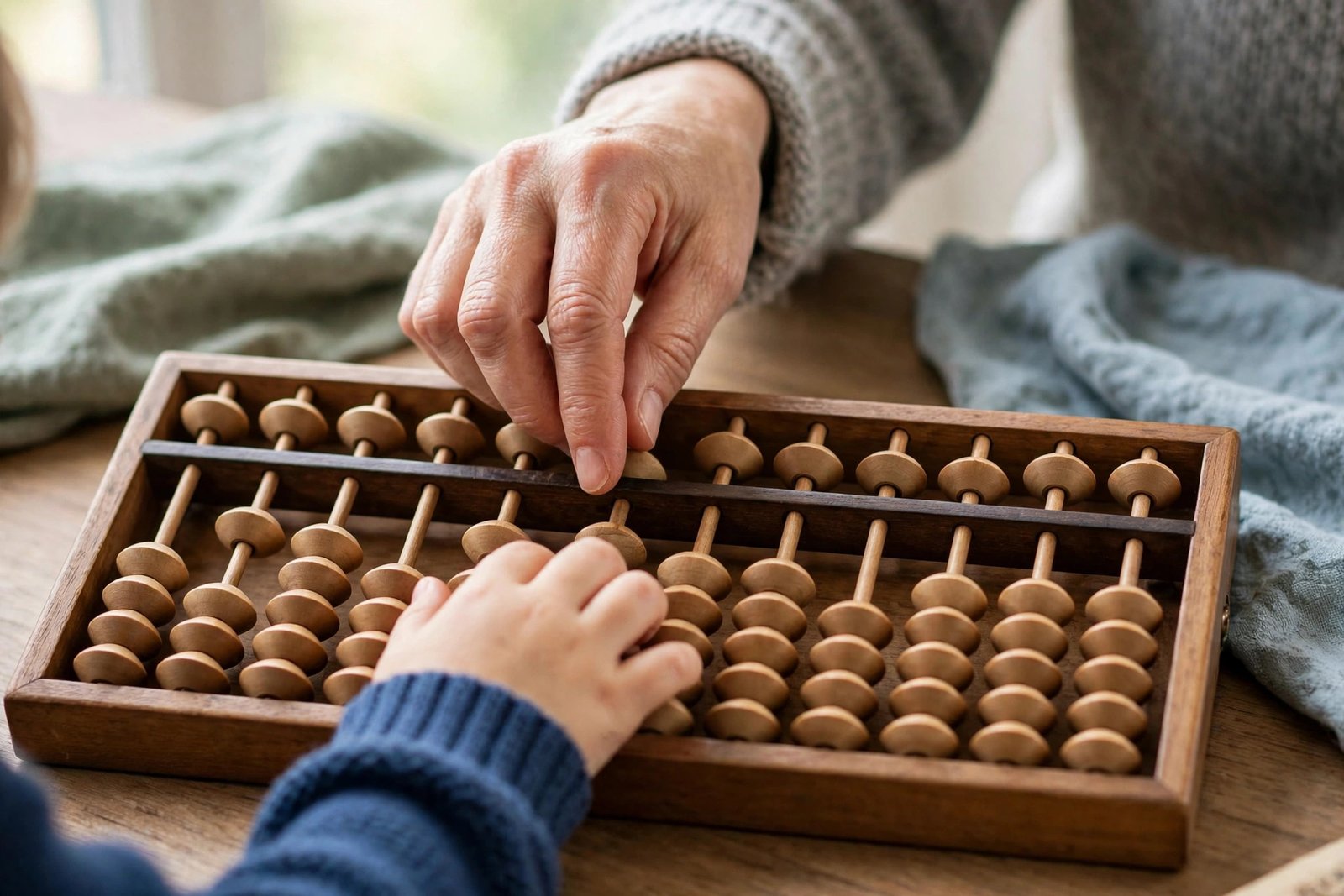
Small friends matter because of how a single abacus column is built. Each column has four lower beads worth one each and one upper bead worth five. When the lower beads run out, the upper bead has to be involved, and the small friend pairs tell you how. Big friends matter because of place value. When a column cannot hold any more, value must move to the next column as a ten, and the big friend pairs tell you how much stays behind and how much moves across.
Children who already enjoy addition on the abacus for beginners often meet small friends first, usually within their early weeks of learning. Big friends tend to arrive a little later, when numbers grow beyond a single column. Both systems use the same friendly logic, so learning the first prepares the mind for the second.
The Small Friends: Pairs That Make Five
There are only a few small friend pairs to learn, which is why children find them manageable. One and four are small friends because they make five together. Two and three are small friends for the same reason. Five itself stands as the full set, represented by the upper bead. That is it: one helps four, four helps one, two helps three, and three helps two.
Here is when a small friend is needed in addition. Suppose your child wants to add four to three on one column. Three lower beads are already up. Adding four directly would need four more lower beads, but only one lower bead remains down below. Instead, the child adds five by bringing the upper bead down, and then takes away the small friend of four, which is one, by moving one lower bead back down. Three plus five minus one leaves seven, which is correct. The beads now show seven, and every move was possible.
The same logic works in reverse for subtraction. To subtract four from seven when the lower beads are not arranged for a direct removal, the child removes five and then adds back the small friend, one. It can feel strange at first to add something during a subtraction, so go slowly and talk through the fairness of the exchange: taking away five removes one too many, so one comes back. Once a child explains that idea in their own words, the method is theirs for good.
Teaching Small Friends So They Stick
Teach the pairs away from the abacus first. Use fingers, counters, or drawings of five frames. Hold up two fingers and ask how many more make five. Build a small tower of five blocks, remove two, and count what remains. Songs, rhymes, and quick flash games all help, as long as the pairs are met in many forms rather than one worksheet repeated endlessly.
The Big Friends: Pairs That Make Ten
Big friends are pairs that make ten: one and nine, two and eight, three and seven, four and six, and five and five. There are five pairs, and children who know their number bonds to ten from school maths already have a head start. If those bonds are shaky, spend time on them with ten frames and counters before expecting fluent bead work.
A big friend is needed when a column overflows or cannot give what is asked. For addition, imagine adding six to seven in the units column. Seven is showing, and six more cannot fit because a single column holds at most nine. So the child adds a ten in the next column, one bead in the tens column, and removes the big friend of six, which is four, from the units. Seven minus four leaves three in the units, plus the new ten, giving thirteen. The answer is correct, and the exchange kept every column legal.
For subtraction, the mirror image applies. In thirteen minus seven, the units show three and cannot give seven directly. The child removes one ten from the tens column and adds the big friend of seven, which is three, to the units. Three plus three makes six in the units, and the tens are now empty, leaving six as the answer. This is the bead version of borrowing, and many children find it far clearer than the crossed out digits they meet on paper. Our guide to subtraction on the abacus for beginners walks through gentler early examples if your child needs to consolidate first.
Small Friend or Big Friend: How to Decide
The most common confusion for learners is not the pairs themselves but knowing which system a question needs. A simple decision habit helps. First, ask whether the move fits inside one column using the beads that are there, including the upper bead. If the only problem is the arrangement of beads within the column, a small friend will solve it. If the problem is that the column itself would need to hold ten or more, or give more than it contains, a big friend is needed because value must travel between columns.
Some questions need both friends in sequence, especially as numbers grow. A child might use a big friend to handle the tens exchange and a small friend inside the column to arrange the beads. Do not rush toward those combined cases. Programmes introduce them step by step for a reason. Master small friends in single columns, then big friends in simple two column work, and only then combine them.
A helpful classroom habit is to let the child pause and name the friend before touching the beads. Saying, I need the big friend of eight, which is two, turns a vague struggle into a clear plan. Over weeks of practice that spoken pause becomes silent and instant, which is exactly how fluent mental calculators operate.
Friend Numbers in Two Digit Work
Big friends really come alive in two digit addition and subtraction, because exchanges between units and tens happen constantly. Consider forty seven plus twenty eight. The tens add directly, but the units, seven plus eight, overflow, so a big friend exchange carries a ten across. Working through examples like this shows children that the friend system is not a trick for small numbers only. It scales to any size of calculation, column by column, all the way to hundreds and beyond.
If your child is just moving beyond single digits, the guide to two digit numbers on the abacus gives a calm introduction to setting and reading larger numbers before the exchanges begin. Reading fluently matters because a child who hesitates over what the frame shows has no attention left for choosing the right friend. Build reading speed first, then layer the complements on top.
Practising Friend Numbers Without Drilling Them to Death
Repetition is necessary, but mindless repetition is not. Short, varied practice works best. Begin a session with a two minute pair recall game: call a number and let your child answer with its small friend, then switch to big friends, then mix them. Keep it playful, keep score only if your child enjoys scoring, and stop while it is still fun.
Next, apply the pairs in real calculations, a few at a time. Choose questions that specifically need the friend being learned, so the new idea gets used immediately. A page where every question needs the small friend of three teaches far more than a mixed page where it appears once. Later, mix question types so your child practises the decision step as well, choosing which friend, if any, each question needs.
Finally, let your child invent questions. Ask them to create an addition that needs a big friend, or a subtraction that needs a small friend. Inventing a valid example requires deeper understanding than answering one, and children take pride in setting a challenge for a parent or sibling. This kind of active practice builds the flexible thinking that the wider programme aims for, as described in our overview of carrying and borrowing on the abacus.
Mistakes to Watch For and Kind Ways to Fix Them
One common slip is using the right friend in the wrong direction: adding the friend when it should be removed, or the reverse. The cure is the fairness talk. Ask your child, we added five but we only wanted four, so what must happen to the extra one? Reasoning it out beats memorising direction rules, because the reasoning still works when nerves strike during a test or competition.
Another slip is mixing the pairs, answering the small friend when the big friend was needed. This usually means the decision step needs attention, not the pairs. Return to the pause and name habit for a week, and the accuracy often recovers quickly. A third slip is finger confusion, where the brain knows the move but the hands swap beads. Slow practice with correct finger placement, even for a few minutes a day, prevents that habit from setting in.
Stay patient through this stage. Friend numbers are the biggest conceptual jump in early abacus learning, and a wobbly week here is completely normal. Children who come through it with understanding, rather than speed pressure, are the ones who later fly through mental calculations with real confidence.
Conclusion
Small friends make five and big friends make ten, and those simple partnerships unlock almost every bead move that looks impossible at first glance. Teach the pairs through play, use them in focused calculations, and encourage your child to name the friend before moving the beads. With that steady approach, complements stop being a rule to remember and become a natural way of thinking about numbers, one that supports every abacus skill still to come.


2 thoughts on “Abacus Complements Explained: Small Friend and Big Friend Numbers”