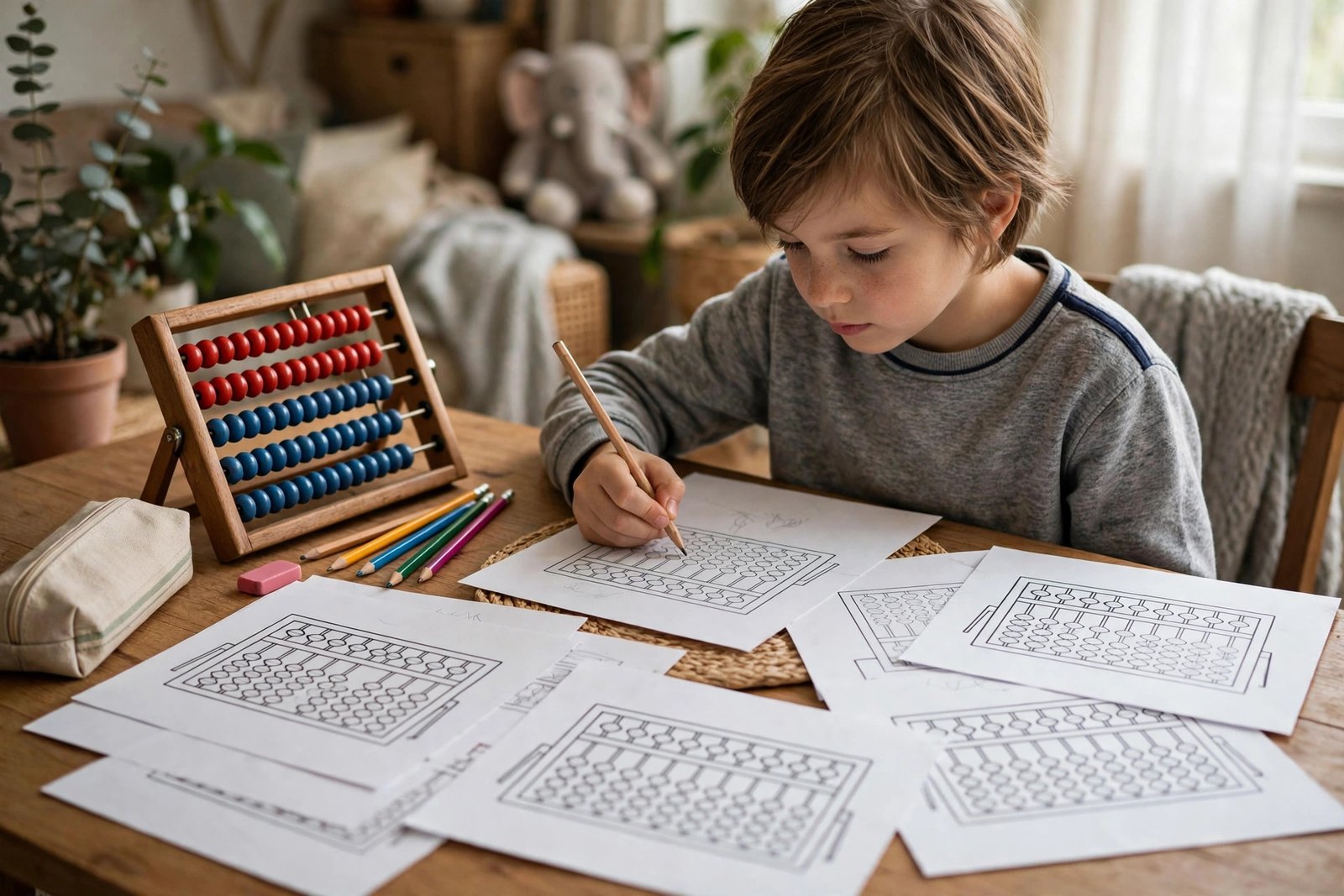
Worksheets have a mixed reputation. Done badly, they are dull pages of identical sums that children rush through and forget. Done well, they are one of the simplest and most effective ways to practise abacus skills at home: focused, progressive, and easy for parents to check. The difference lies in how the exercises are chosen, varied, and used.
You do not need to buy expensive workbooks or print endless pages. A notebook, a pencil, and a clear idea of what your child is learning can produce excellent practice. Many of the best abacus practice worksheets are ones a parent or teacher creates in a few minutes, matched exactly to the child’s current level, because generic sheets are usually too easy, too hard, or focused on the wrong step.
This guide shares worksheet and exercise ideas for every stage, from setting first numbers to timed mixed practice, plus practical tips on layout, checking, and keeping motivation up. Use them to support a class programme or a home learning plan, and adapt the numbers freely. The structure is what matters most.
What Makes a Good Abacus Practice Worksheet
A good worksheet has one clear job. It practises a single skill, such as adding numbers that need a small friend, or subtracting across a ten, rather than throwing every type of sum together. When a child struggles, you can tell exactly which step needs help. When they succeed, they know precisely what they have mastered.
Space matters more than parents expect. Children working with an abacus need room to place the frame, rest the paper beside it, and write answers without crowding. Large, clear numbers with generous spacing help younger children track which sum they are on. Ten to fifteen sums per set is usually enough for focused practice. More than that, quality drops as tiredness rises.
Every worksheet should be checkable. Keep your own answer list, work through the sums yourself once if you are unsure, and mark together with your child soon after they finish, while the method is still fresh in their mind. Delayed marking loses most of its teaching value, because the child no longer remembers how they reached each answer.
Beginner Worksheets: Setting and Reading Numbers
Before addition begins, children need to set and read numbers fluently. A simple and effective worksheet shows a list of numbers in a column, and the child sets each one on the abacus and ticks it off. A second version reverses the job: you set numbers on the frame, and the child writes each one on the sheet. Both directions matter, because reading beads and writing digits are separate skills that support each other.
Add variety with draw-the-beads exercises. On paper, draw empty abacus columns and ask your child to shade the beads for a given number. This paper version of the parts of an abacus helps children think about columns even when the real frame is not in front of them, and it makes a good quiet-time activity.
Keep beginner numbers small and build gradually: single digits first, then numbers to twenty, then two-digit numbers with tidy tens, then any two-digit number. Short daily sets of this kind, lasting just a few minutes, build the fluency that all later work depends on.
Addition Worksheets That Build Step by Step
Addition practice should follow the order the method itself is taught. Start with direct addition, where beads are simply added without any exchange. Then practise sums that use the small friend combinations to five, then the big friend combinations to ten, then sums that carry into the next column. A worksheet that mixes these stages too early invites confusion, because the child cannot settle into the pattern of the step they are learning.
Within each stage, vary the presentation so the skill transfers. Vertical sums, horizontal sums, and missing-number sums, such as seven plus something equals twelve, all practise the same operation in different clothes. Missing-number problems are especially valuable because they prepare children for early algebra thinking and for the inverse relationship between addition and subtraction.
Ideas from addition on the abacus for beginners can be turned directly into worksheets: write the sums your child met in a lesson, in a new order, with slightly different numbers, for the next day’s practice. Familiar structure with fresh numbers is the sweet spot for consolidation, neither boring nor overwhelming.
Subtraction Worksheets and Mixed Practice
Subtraction deserves the same careful staging as addition. Begin with direct taking away, then subtraction using friends, then borrowing from the next column. Many children find subtraction harder because it runs against the counting direction they learned first. Extra patience and smaller sets at each stage pay off quickly.
Once addition and subtraction are each secure on their own, mixed worksheets become powerful. A page that alternates the two operations forces the child to read each sign carefully instead of settling into autopilot. This is a common point of failure in school tests, where a capable child answers every question as an addition because the first few were additions. Mixed abacus practice at home quietly removes that trap.
Include a few comparison exercises too: two sums side by side, and the child must say which answer is bigger before calculating precisely, then check on the abacus. Estimation first, calculation second is a habit that serves children throughout their maths education.
Number Bonds, Friends, and Speed Drills
Some worksheets support fluency rather than full sums. Number bond sheets list pairs that make five or ten, with one number missing, and the child fills the gap as fast as they can while staying accurate. These facts sit at the heart of abacus methods, especially the friend combinations, and instant recall of them makes every later sum smoother.
The concepts behind small friend and big friend on the abacus lend themselves to matching exercises as well: draw lines between numbers and their friends, complete the bead pictures that show each pair, or circle the correct friend from three options. Variety in format keeps the same essential facts from going stale.
Speed drills should be used sparingly and kindly. A one-minute challenge with very simple sums, repeated weekly, lets children see their own fluency growing. Always pair a drill with praise for accuracy, and never use drills before the underlying method is secure. Speed built on shaky steps collapses under pressure, while speed that grows naturally from understanding lasts.
Listening Exercises and Dictation Sheets
Not all worksheets are completed in silence. Dictation exercises, where a parent reads numbers or sums aloud and the child works on the abacus and writes only the final answer, train listening and memory alongside calculation. Keep a simple record sheet: the date, the sums you read, space for answers, and a note of any that needed repeating.
Start with single numbers, then two-step sums, then longer chains for more experienced children. Dictation feels different from written work and many children enjoy the change of pace. It is also excellent preparation for the mental stage of abacus learning, because the child must hold the problem in mind rather than looking back at the page.
If two children practise together, they can dictate to each other in turns. The reader practises speaking numbers clearly and checking answers, and the listener practises concentration. Supervise lightly, celebrate careful work, and keep chains short enough that success is frequent.
Word Problems and Real-Life Exercise Ideas
Calculation skill means little if a child cannot tell when to use it. Short word problems on a worksheet bridge that gap. Write problems drawn from your child’s world: marbles collected and given away, pages read across a week, pocket money saved and spent, goals scored over several matches. Two or three word problems at the end of a practice set are plenty.
Encourage your child to work each problem on the abacus first, then write the answer with its unit: marbles, pages, or coins. Naming the unit teaches them to think about what the number means, not just what it is. Over time, invite your child to invent a word problem for you to solve. Composing a problem requires deeper understanding than solving one, and children find the role reversal delightful.
Real-life mini worksheets can live outside the notebook. A shopping list with prices to total, a recipe to double, a journey split into stages to add up: each is a worksheet in disguise. Pointing this out helps children see how abacus helps with school maths and everyday numbers, and that their practice has a purpose beyond the page.
Timed Challenges and Personal Bests
When a skill is secure, gentle timing adds excitement. Set a mixed set of ten sums and record how long accurate completion takes. Repeat a similar set weekly and chart the times. The chart itself becomes motivating, as children watch their line improve even when day-to-day changes feel tiny.
Keep the rules clear: the clock only rewards correct answers, unfinished sets are fine, and the only comparison is with your own past performance. Some children thrive on timing, others find it stressful. If your child is in the second group, skip timers entirely and track accuracy streaks instead, such as how many sums in a row they can complete correctly. The sense of progress matters, not the particular measure.
Making Your Own Worksheets at Home
Homemade worksheets take minutes. Use a notebook and write sums in a neat column, or type them in any simple document with large spacing and print a week at a time. A reusable trick is to create a master set for a skill, then generate variations by changing one digit in each sum. The method practised stays identical while the answers stay fresh.
Answer keys deserve the same care. Write them as you create the sheet, checking each sum once yourself, ideally on the abacus. This also deepens your own understanding of the method, which makes you a better helper when your child gets stuck. Store worksheets in a folder by stage so you can revisit earlier sets for revision before moving on, or after a holiday break.
If your child attends a class, align homemade sheets with the class level rather than racing ahead. Practising a future topic incorrectly at home creates habits the teacher must then undo. When in doubt, revise current and past topics. Consolidation is never wasted time.
Checking, Correcting, and Learning From Mistakes
How you handle a marked worksheet matters as much as the worksheet itself. Go through errors together, and for each one, ask your child to redo the sum slowly on the abacus while you watch for the step where it changes. Most mistakes trace back to one small moment: a friend forgotten, a column skipped, a sign misread. Finding that moment teaches more than redoing the whole page.
Keep a small mistakes list at the back of the practice notebook. When the same error appears twice, it becomes next week’s mini focus, with a short custom worksheet of its own. This calm, detective approach turns errors into a plan. Children who see mistakes handled this way stop fearing them, and a child who does not fear mistakes practises more honestly and improves faster.
End marking with something positive and specific: a sum type now fully secure, a neater layout, a faster accurate set. File the sheet, note the date, and move on. The growing folder of completed work is itself a quiet motivator, proof of effort that children can hold in their hands.
How Often, How Many, and When to Move On
Little and often wins again. One short worksheet, or one set of ten to fifteen sums, on most days fits naturally into a daily abacus practice routine without overwhelming homework time. Two shorter sets with a break suit some children better than one longer sitting. Experiment and keep what your child tolerates happily.
Move to the next stage when the current one is accurate and reasonably fluent across two or three separate days, not just once on a good day. If accuracy drops sharply, the step was not ready. Return kindly, rebuild, and progress again. Steady staging feels slower in the short term and is much faster over a year, because it avoids the confusion that comes from building on sand.
Conclusion
Good abacus practice worksheets are focused, well-spaced, matched to your child’s current stage, and checked together soon after completion. With beginner number work, staged addition and subtraction, number bond drills, dictation, word problems, and gentle timed challenges, you have everything you need to create effective practice at home with nothing more than a notebook and a pencil. Keep sets short, handle mistakes calmly, and let the growing folder of finished work show your child how far they have come.